


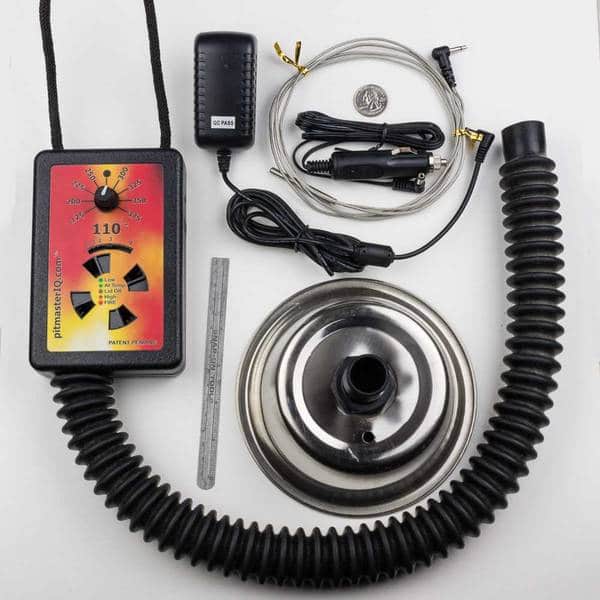
The Pitmaster IQ110 is a straightforward temperature controller for charcoal grills and smokers. The controller and the fan are integrated into one plastic housing with air suppled to the cooker via a corrugated rubber hose and manifold that mounts on the cooker’s air vent. A separate probe clips to the cooking grate and supplies temperature feedback to the controller. There are no additional probes for monitoring food temperature.
How the Pitmaster IQ110 Works
Unlike most thermostatic controllers that have a digital temperature input and readout, the IQ110 uses a knob to set the temperature and a multi-colored LED to indicate the temperature status. This LED flashes green when the cooker temperature is 10° or more below the set point, solid green when within 10°, solid red if the temp is between 10° and 49° above the set point, and flashing red if the temp is more than 50° above the set point. The LED can also alternate between red and green. This indicates that either the lid-open delay is in effect or that the controller has overheated or the probe is defective.
There is a damper control that allows the user to throttle back the airflow if the temperature fluctuations are excessive. The instructions state that some manipulation of the damper and the cooker vents might be required to find the right combination of airflow to yield a stable temperature. For this test, the damper was fully open. The air is routed through the supplied hose into a bell-shaped manifold that mounts over one of the lower vents. This is held snugly against the cooker using a supplied screw and nut, and is easily fitted or removed. (The screw that secures the manifold is longer than it needs to be, and interfered slightly with centering the charcoal ring, but this is a very minor issue.)
Controller Testing
Test Procedure: we tested this product on an 18.5″ Weber Smokey Mountain. I loaded 2 lbs. of Kingsford Competition Briquets into the cooker, and lit 1 lb. of the same charcoal in a chimney, and poured it on the unlit coals already in the smoker. The water bucket was about 2/3 full, and there was no food in the cooker. The air manifold was inserted over one of the lower vents, and the others were closed. The temperature probe was clipped to the center of the top cooking grate. Another temperature probe was mounted close to the sensor and plugged into a ThermoWorks BlueTherm Duo that was monitored on my computer for temperature recording purposes. The set temperature was 225°F, consistent with smoking practices.
The outside air temperature was around 70-90°F. Winds were calm. Measurements began shortly after the smoker was closed up. The charcoal burned for a little over five hours before the blower began to run full-time, signaling that the fuel was nearly exhausted. At that point, I terminated the test. The captured data from the ThermoWorks sensor was plotted, and the raw data was exported to Excel so that I could calculate temperature maxima, minima, average and standard deviation. The last value gives a measure of how consistent the temperature remained. If the temperature was dead constant, the standard deviation would be zero. The larger the swings in temperature, the higher the standard deviation would be. The values for this test are:
Minimum temperature: 196.5°F
Maximum temperature: 224.6°F
Average temperature: 212.7°F
Standard deviation: 5.51°F
Results
I set the temperature control knob to 225°F as nearly as I could, and took whatever temperature the unit produced. As you can see, the controller hovered around 212° when visually set to 225°. Without another temperature measuring device, you have to trust the calibration of this unit as the only feedback you get is from the LED status indicator. I would recommend using a separate thermometer to monitor the cooker temperature due to the inherently lower precision to which one can read an analog knob. There are several such units in this database, and you DO want to know your food temperature as well, right?
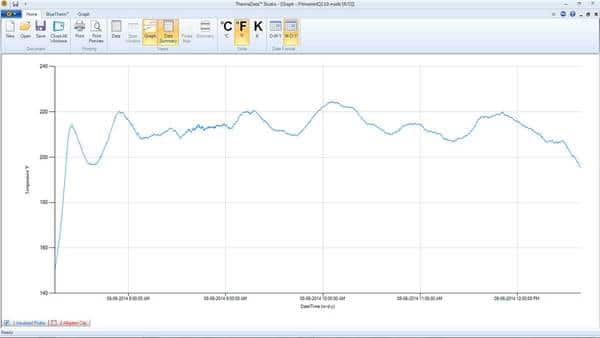

Overall, the controller kept the temperature within a range of +/- 8°F. This is probably fine for cooking, although other controllers did a better job of temperature regulation. You can click on the temperature vs. time graph above to see a larger version.
Warranty
The instruction manual is reasonably complete and well-written. The main components – controller/blower, power supply, and the probes – come with a 90-day warranty. You can find the manufacturer’s contact information, including address, website, e-mail and telephone numbers in the owner’s manual.
Our Review of the Pitmaster IQ110
We give this unit a Bronze medal for its low price, straightforward operation and average performance. At only $140, it’s relatively inexpensive, so it represents a good value as a basic thermostatic controller. It seems odd to use something with analog controls in this digital age, but performance is what counts.