


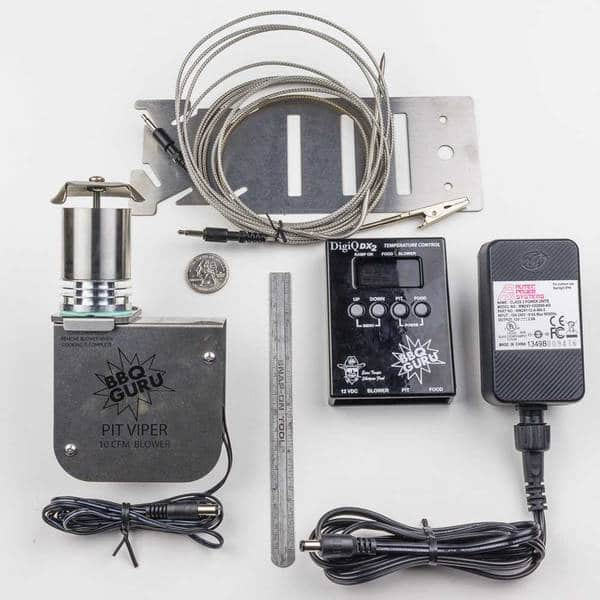
The BBQ Guru DigiQ DX2 is a thermostatic controller with an extra probe to monitor food temps. The configuration tested used the adapter for Weber Smokey Mountain smokers and a 10 cfm blower fan.
The controller accepts two temperature probes, one to monitor the cooker temperature and another to monitor the food temperature. Two alarms are available. One allows you to set a threshold that will sound an alarm when the cooker temperature goes above or below the set temperature by an amount greater than you set. The default is 50ºF, so the alarm will go off if the inside temperature drops below 175° or goes above 275°, assuming the set point is 225°. The other alarm sounds when the food temperature reaches the value you have set. The sound intensity of the alarms is adjustable.
The user can select between F and C temperature scales. The temperature display on the control box “snaps to” the set temperature when the actual measured temp is within 5ºF of the setting. This has the disadvantage of masking small temperature fluctuations, something I’d prefer to be able to monitor.
Programming
Two programmable features provide some operating flexibility. If the ramping feature is turned on, the set temperature of the smoker will automatically lower itself as the food approaches its set temperature, preventing over-cooking. It is difficult to predict how this might affect cooking times. The second feature auto-detects when the smoker cover is opened. Normally, opening the cover will lower the temperature inside, causing the blower to over-react and create a spike in the temperature. With this feature active, the blower won’t turn on right away. The owner’s manual warns that having this feature on can cause the cooker to be slow to come up to operating temperature when first lit.
The adapter that fits into the Weber smoker goes in easily and can be easily removed. The blower is inserted into this adapter. There is a slide damper on the blower to allow you to reduce the output of the fan. This is useful to preventing temperature overshoot when cooking at a low temperature on a smaller cooker. It can be opened to yield the full output of the fan if using a higher cooking temperature or low ambient temperatures where more airflow might be required.
Construction
The control box is heavy-duty, made of all metal. The power supply cord is also stoutly built. The wire to the blower fan appears much more fragile. The stainless-steel braided cooker probe has an alligator clip allowing you to attach it to the cooker’s grate. The food probe, also a stainless-steel braided cable, has a pointed probe that is L-shaped and a bit on the short side at 4″ (10cm) long. The cables are a generous 80″ (2m) in length.

Testing the BBQ Guru DigiQ
Test Procedure: This product was tested on an 18.5″ Weber Smokey Mountain. I loaded 2 lbs. of Kingsford Competition Briquets into the cooker, and lit 1 lb. of the same charcoal in a chimney, and poured it on the unlit coals already in the smoker. The water bucket was about 2/3 full, and there was no food in the cooker. The Weber adapter was inserted into one of the lower vents, and the others were closed. The temperature probe was clipped to the center of the top cooking grate. Another temperature probe was mounted close to the sensor and plugged into a ThermoWorks BlueTherm Duo that was monitored on my computer for temperature recording purposes. The set temperature was 225ºF, consistent with smoking practises.
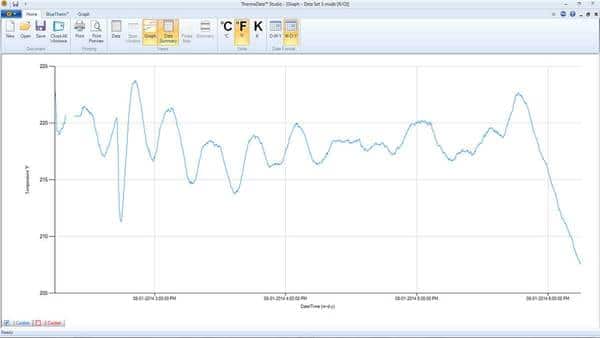
The outside air temperature was around 104ºF. Winds were light and variable. Measurements began shortly after the smoker was closed up. The charcoal burned for a little over four hours before the blower began to run full-time, signaling that the fuel was nearly exhausted. At that point, I terminated the test. The captured data from the ThermoWorks sensor was plotted, and the raw data was exported to Excel so that I could calculate temperature maxima, minima, average and standard deviation. The last value gives a measure of how consistent the temperature remained. If the temperature was dead constant, the standard deviation would be zero. The larger the swings in temperature, the higher the standard deviation would be. The values for this test are:
Minimum temperature: 213.8°F
Maximum temperature: 223.8°F
Average temperature: 218.3°F
Standard deviation: 1.83°F
Results
Overall, the controller kept the temperature within a closely regulated band, although the average temperature was a bit below the setting chosen for the test, 225°F. As the test progressed, the temperature regulation improved, possibly because the learning algorithm employed by the controller had calibrated its response to the Weber. The temperature vs. time plot is below – click on it for a larger version
Our Review of the BBQ Guru DigiQ
Setup and operation are straight-forward. The instruction manual is complete and well-written, although there are a couple of minor typographical errors in it. The main components – the controller, power supply and blower – are warranted for one year and the probes come with a 90-day warranty. The manufacturer’s contact information, including address, website, e-mail and telephone numbers are found in the owner’s manual.
We give the BBQ Guru DigiQ unit a Silver medal for ease of use and generally good performance. At nearly $300, it’s not cheap, but it will save you a lot of time fiddling with your vents.