

Mary had a leg of lamb… And she ate every darn bite!
Leg of lamb is a complex bundle of muscles and groups of muscles, with layers of fat and connective tissue throughout. It is thick at the hip end and tapers to the ankle end like a ham, and enough to feed eight or more. Here are four grill roasted lamb recipes for dealing with the wonderful log of meat. Plus, how to create deliciously smoky grilled leg of lamb.
1) Bone-in
One way to cook a leg of lamb is to trim off the exterior fat cap, flavor the exposed muscle meat with a rub or marinade, and cook it the way nature made it, bone in. The fat cap just keeps flavor from getting to the meat, so it really has to go. Contrary to myth, the external fat doesn’t make the meat moister. Melting fat on the surface will not penetrate the meat, it just runs off, and it will only block the seasonings from getting onto and into the muscle. And contrary to another myth, the bone doesn’t add any flavor, but it does a pretty good job of holding all the muscles together.
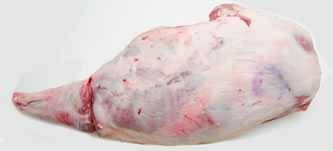
The thick end can be cooked to a perfect medium rare, while the narrow end will be closer to well done. There’s always someone who doesn’t like red or pink meat, so this may suit your guests.
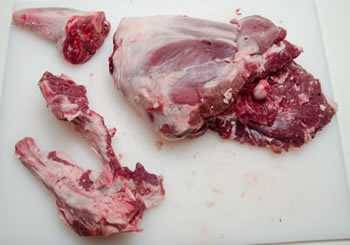
Tips and tricks
If you are going to cook a bone-in leg, have your butcher remove the shank, at top left in the picture. The bone is hard to cut through at home without a bone saw. This is the end that tapers to the ankle. It is tough, laden with leathery tendons, and always cooks well done because it is so narrow. Save up a few in the freezer, smoke them, and make a stew.
Have your butcher remove the “aitchbone” to make carving a lot easier. This is part of the pelvic bone and it has the socket into which the ball of the thigh bone fits. In the photo, you can see the aitchbone in the lower left, the ball of the femur (thigh bone) peaking out of the big hunk of meat (the thigh), and the tibia and fibula (shank) in the upper left.
At-home removal
The aitchbone is a major pain to remove at home. If it is still there when you get home, dig under it with your fingers and then use a stiff knife to cut around the bone to release it. This can take you 30 minutes or more if you are careful to trace the odd shaped bone so you don’t waste any meat. There are several tendons connecting it. So just take your time and trace around the aitchbone with your knife until it comes off. And watch your fingers. I got a nasty cut doing this once. If you accidentally remove a good chunk of meat, set it aside, you can stick it into the roast near the ball and hold it in place with kitchen twine.
There is an ugly tasting gland nestled in a triangle of fat near the knee. It won’t ruin the meat when you are cooking, but when you carve the meat, be on the lookout for it. It is not as hard as bone, more like cartilage. You can see it in the picture below. Make sure you don’t serve it to anyone you like.

2) Boneless roast
Another grill roasted lamb recipe involves buying boneless legs, and that’s what I usually do. When you buy boneless leg it comes rolled and tied into a more symmetrical shape, so it cooks more evenly and it is easier to carve with no bones in the way. It can easily be stuffed. You can have your butcher bone a leg for you: Just make sure you ask for the gland to be removed.
Or you can bone it yourself, but it is tricky. Remove the aitch, the femur, and the shank, and any large deposits of fat, including the gland, then slather the meat with seasonings, and try to roll it back and tie it up. You can even stuff it with dried fruits and/or seasoned bread crumbs. Prunes are a classic stuffing. Watch this video of a pro boning a leg.
3) Butterflied
Another great way to cook leg of lamb is to bone it out but not roll it up. When you are done you’ll have a big flap of meat, perhaps 2′ x 2′ (61 x 61 cm) and ranging in thickness from 1″ to 4″ (2.5 to 10cm). Just leave it open flat—butterflied. The top will be fairly even and smooth, but the bottom will be irregular and have mountains and valleys from the deboning effort. These nooks and crannies are perfect places to hide flavors.
Just rub it on all sides with Dolly’s Lamb Rub And Paste, let it marinate a few hours or overnight, and then roast it first over indirect heat at about 225°F (107°C), and when it hits 115°F (46°C) or so in the center, move it over a hot direct flame and sear it dark. This is called reverse sear. Read more about reverse sear here.
4) Spiedies
Another method is to cut the leg meat into chunks and make kebabs or just grill them as chunks. In Western New York they are an art form called spiedies.
Grill roasted lamb recipe

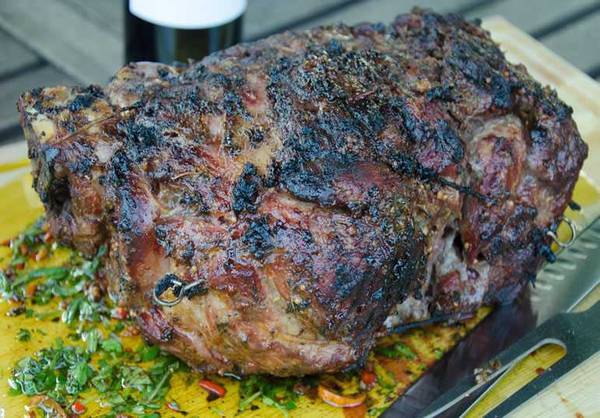
Grill Roasted Leg of Lamb Recipe
Rate this RecipeIngredients

Method
- Prep. Start the day before if you can by removing as much of the thick fat cap on the surface as possible and all the silverskin underneath. Remove the bones, or not. Your choice.
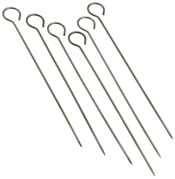
- Now gash the surface by stabbing it repeatedly about 1/2" (13mm) deep and 1" (2.5cm) apart or run a sharp blade across the surface in a checkerboard pattern making squares 1 to 2" (2.5 to 5cm) wide. Click here to read more about the technique of gashing. Sprinkle the salt all over the meat going lighter in the thinner areas. This is called dry brining. Click here to learn more about the concept. Now use butcher string and tie the whole floppy mess into as much of a log shape as possible so it will cook evenly. Your string and knots are going to look sloppy, and you may have problems with loose flaps of meat on the ends, but get them tucked in. I've been known to use toothpicks, and even turkey lacers (shown here). Put it in a pan, and leave it in the fridge overnight.
- Make the Dolly's Lamb Rub And Paste and swab the paste all over the meat and deep into the gashes.
- Fire up. Preheat the cooker in a 2-zone setup so the indirect side is about 225°F (107°C). I know a lot of recipes call for higher temps, but I'm here to tell you, this cut performs much better at low temps so the tough connective tissues and copious fat can liquefy (read more about this concept in my article about meat science). If you have a digital thermometer with a probe that can be left in, insert it now. If you are cooking bone-in, make sure your thermometer probe is about 1" away from the bone in the thickest piece of the meat. If you wish to add some smoke flavor, add a small amount of dry wood now, perhaps a handful, depending on your cooker. The more ventilation the more wood.
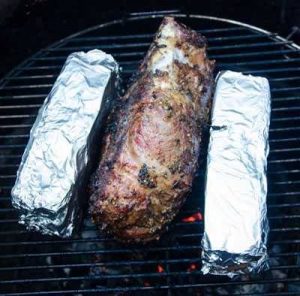
- Cook. Place the leg of lamb on the indirect side and cook with the lid down until the meat hits about 110°F (43°C). Then move the whole clod of meat over to the direct heat side and sear it until it is dark on all four sides or until the meat is 130 to 135°F (54 to 57°C) max. In the photo above you can see how I used a pair of bricks wrapped in foil to hold the roast on edge and get an all-over sear.
- Prep again. While the meat is cooking, prepare a board sauce, heavy on rosemary and/or mint. You can make it in a bowl or cup.
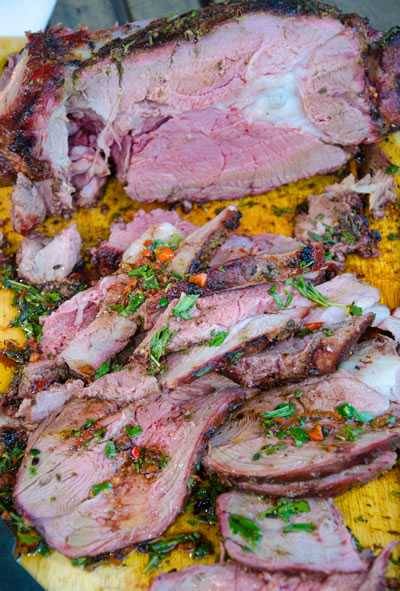
- Pour the board sauce on the board, plop the meat on top of it and start carving. You want the juices to mingle with the sauce.
- Serve. Carve the meat across the grain into 1/4" (6mm) slices as needed and let the meat get plenty of sauce on it just before serving.