


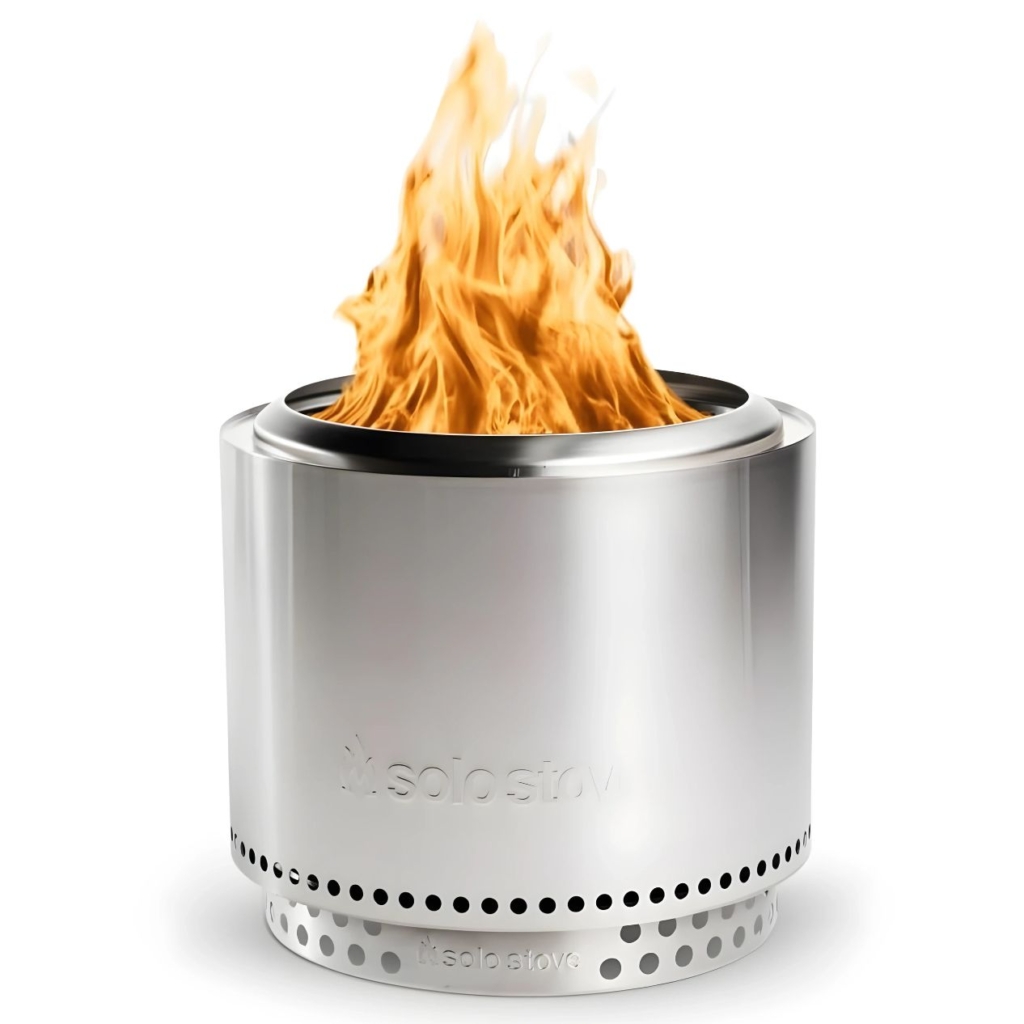
An efficient wood-burning fire pit that makes the annoying smoke disappear
We love spending time in our backyard. But once the weather turns cool, we use it less and less. At least this was true before we decided to join the firepit revolution with the addition of the popular Solo Stove Bonfire 2.0.
Crafted from 304 and 430 stainless steel and finished with a high-heat ceramic coating, this small but mighty double-walled fire pit is built to last. Assembly couldn’t be easier, with no tools required to put together the various parts. These include the main body, a removable ash pan topped by a perforated base plate and an angled fire ring that sits on top of the main body. Once those parts are set in place, the main body is placed on a bottom base that lifts the unit off the ground and protects whatever you have the fire pit set on. Both the removable ash pan and perforated base plate, which fit snugly inside the main body, are recent additions to the unit, making it exponentially easier to clear out ashes between uses.
Configuration options
The new Solo Stove Bonfire weighs only 20 pounds and comes with a heavy-duty travel bag, allowing you to take it camping, to the beach, or to a friend’s home. It has a diameter of 19.5″ and a height of 17.5″. The Solo Bonfire (MSRP $349.99) is billed as the ideal size for gatherings of 4-6 people. Looking for a smaller firepit? Solo’s 15″ diameter Ranger seats 2-4 (MSRP $249.99). Larger? Select between the 27″ diameter Yukon which seats 6+ people (MSRP $549.99), or the massive 30″ diameter which seats 8+ people (MSRP $699.99).
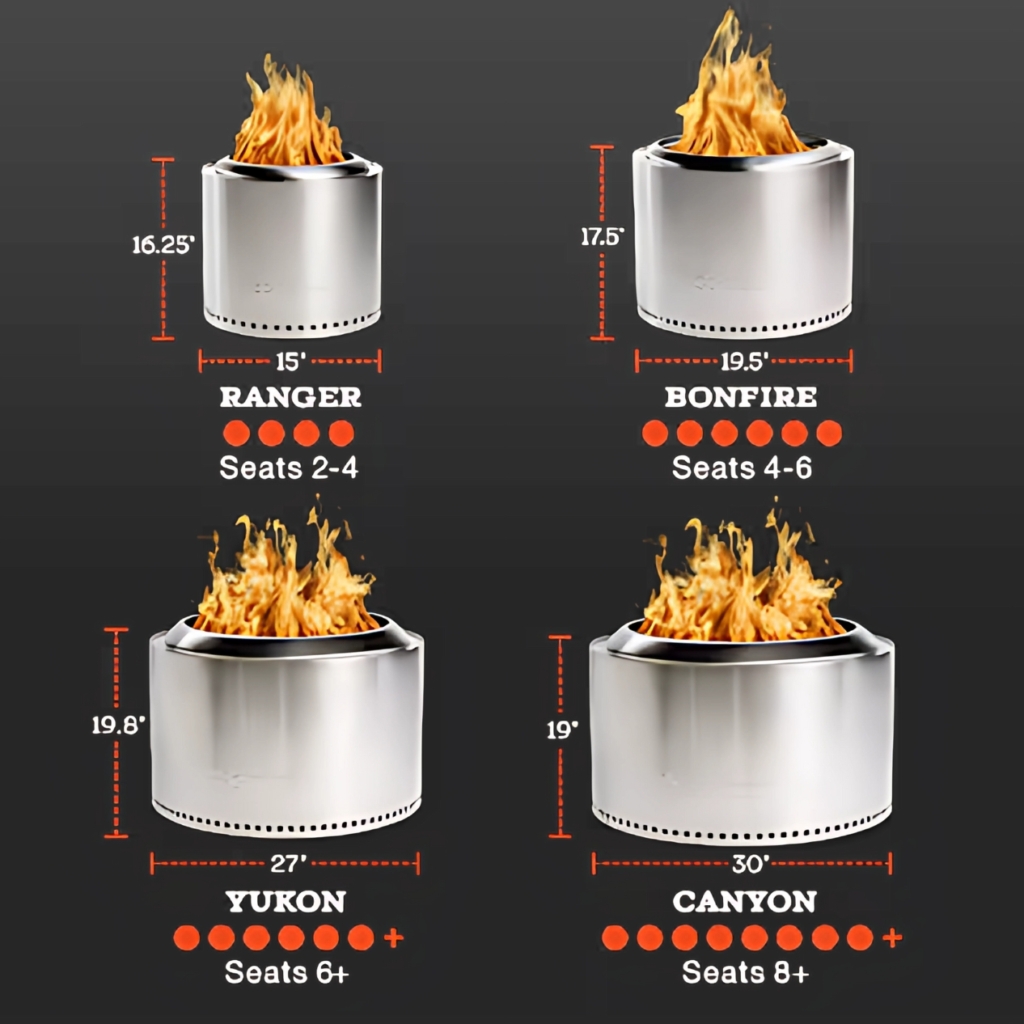

The Solo Stove Bonfire 2.0 is available in silver, stainless steel, mulberry, bronze, deep olive, ash (black), gunmetal, cascade (green), and water (blue).
Unlike a large number of firepits that generate a ton of eye-watering smoke, the Solo Bonefire 2.0 is billed as “smokeless.” To achieve this, air is drawn in through the exterior airholes that circle the bottom of the main body. Air then enters the main chamber through a cold air intake gap around the ash pan. The unit’s innovative 360 degree airflow system then allows air to be pulled up between the double walls of the main body and thus almost completely eliminates escaping smoke (more on this later).
How to start a fire in Solo Stove Bonfire
To start a fire in the Bonfire 2.0, I followed the manufacturer’s recommendations and began by adding some firestarters, though you can also use kindling, and either wood chunks or small logs. For the primary wood, I prefer a seasoned (i.e., aged for drying) hardwood like oak, which I find burns hotter and longer than softwoods, thus requiring less time spent feeding it more wood so you can enjoy your company.
When selecting logs, the manufacturer notes that they should not be longer than 12-16″ as you do not want them to extend beyond the top edge of the firepit. Smaller splits of wood (3-6″ diameter) are also preferred so there is sufficient airflow, as the design of the Solo firepits relies on secondary combustion to function properly. Do not overpack the wood, making sure that there is sufficient space between the logs so air can circulate well within the fire pit. I used a loose criss-cross pattern with the wood. If the air does not circulate well, then it does not allow the Solo firepit to function properly.
Once lit, if you are still seeing smoke, you didn’t do it right! Less wood + better air circulation = no smoke.
How Is Solo Stove Bonfire “Smokeless”?
Now for the big question: How exactly does this smokeless system work? First, air enters the unit through bottom holes to fuel the initial flames with an oxygen updraft. Next, Solo’s secondary set of vents at the top of the double-walled design inject preheated oxygen to create a secondary burn. Simultaneously, the unit’s 360 degree airflow system draws smoke into the secondary combustion chamber between the walls, where the smoke is burnt off instead of escaping into the air (and into your eyes, lungs, and clothes!).
According to Bill Karau of the platinum medal-winning Karubecue C-60 cooker, “when wood is subjected to extreme heat, the moisture evaporates as steam, and then the cellular structure breaks down into smoke which is a gas composed of volatile organic compounds (VOCs) and microscopic particles.” So essentially, the Solo design burns off those VOCs within the secondary combustion chamber instead of allowing them to go up and out of the unit.
If you follow the fire-building instructions above, the Solo Stove Bonfire is so effective and efficient that you should get up to 2.5 hours of burn time before you need to add more wood. For ash disposal, I found that the removable ash pan made clean up super simple after each burn—though you can likely go 2-3 uses given how efficiently the unit uses wood.
Conclusion
Overall impressions? The Solo Stove Bonfire delivered everything it promised in a smokeless firepit. Also, the price is more than reasonable given the innovative dual chamber design and the use of 304 and 430 stainless steel that should extend its lifespan if well maintained. As such, I gave it a Gold Medal as I believe it has notably enhanced the overall firepit experience with its smokeless design and burn efficacy.
Warranty
Solo Stove’s warranty covers manufacturer defects for a lifetime, but not normal wear or misuse.
We thank Solo Stove for providing a Bonfire 2.0 for our tests.