
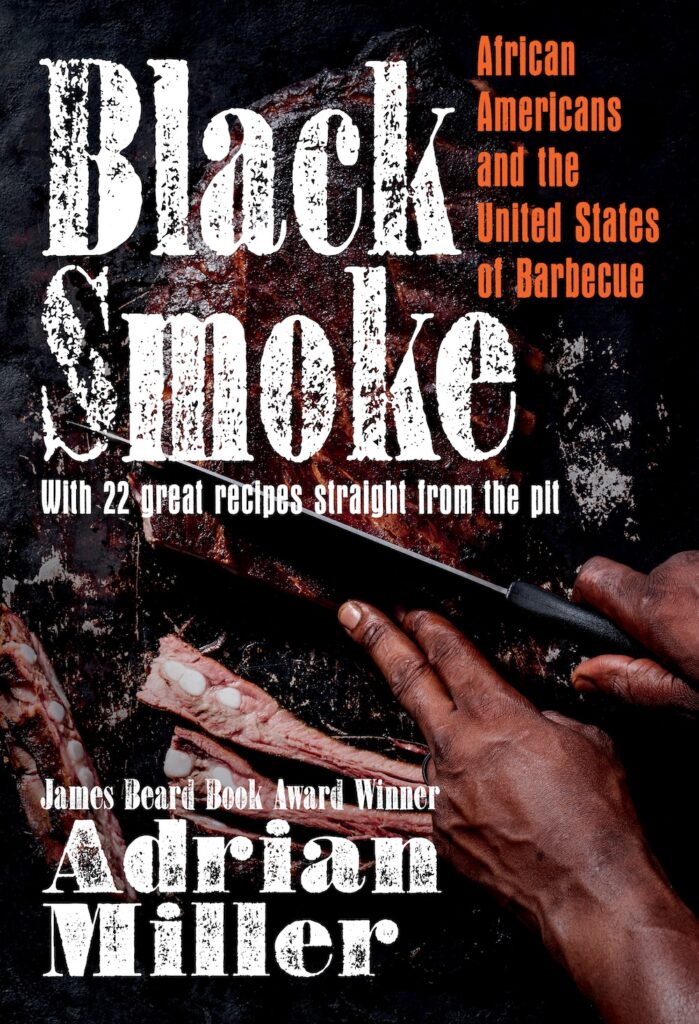
Barbecue is so beloved that its factual history can get clouded in a haze of hotly contested opinions. Black Smoke: African Americans and the United States of Barbecue clears the air. Adrian Miller, a James Beard Award-winning author and certified barbecue judge, shares historical documents, illustrations, photos, and 22 recipes that re-center the role of African Americans in the American barbecue tradition. The book is part food history, part cultural reclamation, and part smoky love letter to the unsung Black pitmasters who built American barbecue—one whole hog at a time.
A bone to pick
In the Introduction, Miller explains how a 2004 episode of Paula Deen’s Food Network show sparked his research. After watching “Paula’s Southern BBQ,” Miller writes “I was stunned that not one single African American had been interviewed on camera. I saw shots of Black people in the background doing the actual work, but they were anonymous and voiceless. Today it may seem naive, but I recall thinking, as I turned off the television, ‘Is this what Black barbecuers have become? They’re just B-roll footage now?’”
Unearthing the roots of American barbecue
To set the record straight, Black Smoke begins by tracing the origins of American barbecue to the labor and ingenuity of enslaved Africans in the 17th and 18th centuries. Miller disagrees with the “Caribbean origins theory” of barbecue, which holds that barbecue began with Indigenous island tribes and traveled north with Spanish explorers. Instead, Black Smoke documents how enslaved Africans in Virginia adapted cooking techniques learned from Native Americans to develop the whole-animal, Southern-style, wood-smoked pit barbecue that is so beloved today. Miller goes on to explore barbecue’s role in church culture and how, by the 19th century, African Americans had become barbecue’s go-to cooks. He also documents how Black entrepreneurs in the 20th and 21st centuries brought Southern barbecue all over the United States. Along the way, Miller revives the legacies of key African American figures in barbecue history such as:
- Charles W. Allen, a renowned pitmaster from Lexington, VA, who was hired to oversee an annual church barbecue in Boston that attracted 60,000 guests by 1897.
- Henry Perry, the “Father of Kansas City Barbecue,” credited as the first person to sell barbecue commercially in the city.
- Henry “Poppa” Miller, named the “Barbecue King” of Kansas City after barbecuing 15,000 pounds of beef, pork, and mutton for an event in 1902.
Miller has done the painstaking archival work of unearthing, analyzing, and amplifying the voices that have too often been left out of the conversation—despite having built the pits, stoked the fires, and cooked the meats. Throughout the Black Smoke, Miller pays homage to a pantheon of pitmasters and restaurateurs, African American men and women who left their indelible marks on the American barbecue landscape. His message is clear: You cannot talk about barbecue without talking about African Americans.
A focused definition
My only nit to pick is with the book’s somewhat narrow definition of barbecue. At the beginning of Chapter 1, Miller declares: “Barbecue’s history, or prehistory to be exact, begins with the Indigenous peoples in the Americas.” Clearly, he’s referring to American barbecue, specifically Southern barbecue. My definition of barbecue is broader, including various forms of low-and-slow wood smoking and hot-and-fast grilling done with all kinds of foods all over the world—from Japanese yakitori and Indian tandoori to Turkish kebabs and Mexican barbacoa. Under that definition, barbecue has a much older and more universal history.
It’s a minor quibble. While I might wish for a broader lens on what counts as “barbecue,” I also recognize Miller’s definition isn’t just culinary—it’s political. He’s staking a claim, drawing a line in the soot, and saying: This is ours. And rightly so. Black Smoke is a significant contribution to the literature on barbecue, providing long-overdue recognition of the African American roots of our American culinary tradition. If you care about barbecue—not just the taste but the truth—you owe it to yourself to read it. Or at least, check out the book excerpt “How Did ‘Barbeque’ Get So Black?” that the author generously shared with us.
To learn more about Adrian Miller, check out his bio here or his website here.