

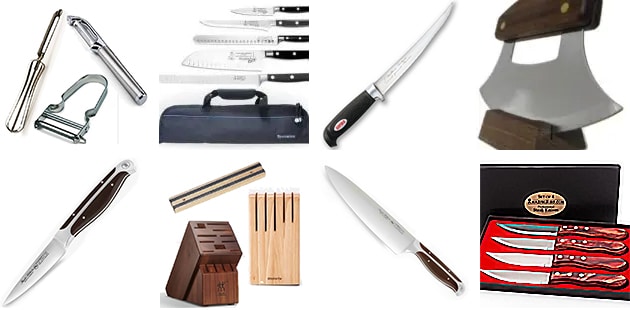
A few sharp, good quality knives are the most essential tools in any kitchen.
The TV Chefs all have their own brands, and the cooking school instructors rave over the $300 Shun Elite and Kyocera, and other really expensive blades that are made from space age ceramics or hand forged from secret alloys and fitted ebony handles.
But the dirty secret is that restaurants use much cheaper knives that they sharpen frequently or even throw away when they wear out. For our wedding in 1974, my wife and I were given a beautiful set of Henckels, high quality German knives, and they’re still going strong with professional sharpening every year.
Click Here To Search Our Reviews And Ratings Of Tools, Toys, And Accessories
Today, Günther Wilhem knives are my all-time favorites. They are durable, sharp, and absolutely beautiful.
The best knives are made of special alloys that remain hard and keep their edge, yet are soft enough that they can be sharpened, a process that grinds away small parts of the steel. The best knives are forged, a process of pounding and grinding. The tang, the tail part that goes into the handle, goes all the way to the end of the handle, and is riveted into the handle, which should have a comfortable grip.
The handle should be tight against the tang so no water or food can get into it. The best knives are well balanced and easy to handle. Forged knives have an integral bolster (shield) between the blade and the tang. Alas, high quality knives should not go through the dishwasher. The caustic soap dulls the blade.
Does this mean you need to spend hundreds of dollars on an entire set of forged knives? No. Just a few good quality knives are all you really need. Before you buy, learn everything you need to know about knives here. You can also read the nitty gritty on the pros and cons of different metal alloys and knife manufacturing methods in our article on The Science of Knives here.
Once you have an idea of the right knife for you, here are some fine options. Remember: no matter what knife you buy, the most important thing is that it feels good in your hand. Balanced, not too heavy, not too light, and not so long or so short that cutting seems like a chore. Visit a cookware store and pick up a few knives to get a sense of how different ones feel in your hands.