
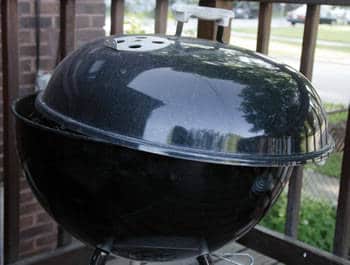
Most grills come with lids. And a good thing, too. A lid is essential for most outdoor cooking. You can cook on a lidless grill, but you will be severely handicapped. It would be like doing all your cooking on a stovetop.
With a lid, most of the heat comes from below, but much of it goes right past the food and is reflected from above so your grill becomes an oven and you can cook foods with heat from all sides. This significantly reduces the risk of burning dinner.
A lid also traps smoke, moisture, and flavor molecules. In short, it gives you much more versatility. And let’s not forget, it keeps flies off the food.
As a rule of thumb, if the food is 3/4″ or less, no lid. Leave the lid off when you are cooking thin foods like or skirt steak. Without a lid, all the heat comes only from underneath. One side cooks, the other does not. For something like skirt steak we want a dark exterior loaded with the compounds formed when proteins, amino acids, and sugars undergo the Maillard reaction (read my article on why brown is beautiful). But you don’t want the interior overcooked. If you close the lid, heat attacks from above and below, and the bottom gets nut brown, but the top just gets to tan, and the center overcooks. So, for thin foods, crank up the heat, leave the lid off and flip the meat every minute or so to prevent heat buildup on either side. This way you’ll be able to develop the dark exteriors without overcooking the interior. For an extreme example, see my article on extreme steak and check out the “afterburner method”.
There are other times when you want to cook without a lid, usually when you are cooking foods like shrimp where the color is your guide to doneness, or sweet foods like pineapple where the surface can burn quickly.
But if the food is 1″ or thicker, put a lid on it. If you leave the lid off, there’s a chance you’ll have an undercooked interior. Of course all this depends on your grill and how much heat you are generating. Yet another reason to have a high quality digital thermometer.
There is a middle ground. Sometimes you might want to wedge the lid open an inch or two to allow hot air escape if you are having trouble getting the heat down to a target such as 225°F.
Unless otherwise noted, almost all the recipes on this website require you to cook with the lid down.