

Cooking is all about controlling heat. Whether you’re cooking indoors or out. If you are cooking with charcoal or wood, you need to understand and gain control over the grill’s environment.
A charcoal or wood cooker is simple. There is fuel, the combustible material (charcoal or wood), and oxygen. You control temp by controlling one or the other, or both.
In most cases you want to cook with the lid down and with a 2-zone setup. This gives you control of oxygen flow and that gives you control of temperature.
How vents control temp
Most grills and smokers have two oxygen controls:
1) An intake damper that brings oxygen to the fire.
2) An exhaust damper (a.k.a. flue, vent, or chimney) that exhausts gases and pulls in oxygen through the intake dampers.
The intake damper is near the charcoal or wood and its job is to provide them with oxygen. The intake damper is the engine that drives the system. Close it off and you starve the fire and it burns out even if the exhaust damper is open. Open it all the way and the temperature rises. On most grills and pits you control temperature mainly by controlling the intake damper.
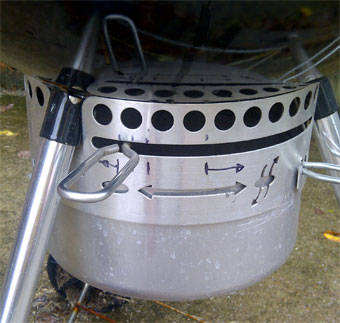
Above is a photo of how John Cooper of Murfreesboro, TN, marked the settings on his Weber kettle. He explains “There are four marks. The outer two marks (with the arrows extending) show where full open and full closed begin. The inner two marks are half open and quarter open. Notice they are not linear but that’s due to the shape of the dampers and the arc of their travel. In this photo the grill is set between quarter open and full closed which is the area where most of my four hour cook occurred while trying to maintain 225 to 235°F.”
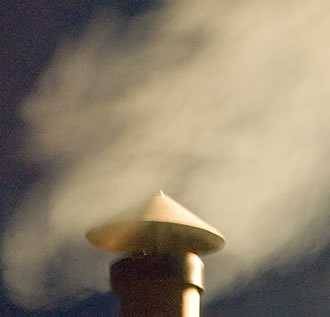
The exhaust damper (a.k.a. flue, vent, or chimney) has two jobs: (1) Allow the combustion gases, heat, and smoke to escape, and (2) pull oxygen in through the intake damper. This pull, called draft, is created by hot gases rising through the chimney trying to escape.
The exhaust damper needs to be at least partially open at all times in order to keep combustion gases from smothering the fire like a wet blanket of CO, CO2, and other combustion products. Oxygen cannot reach the coals unless there is a place for combustion gases to exit. This is even true if you use one of those nifty blower thermostat gizmos like the PartyQ. As heat, combustion gases, and smoke exit the chimney, they create low pressure inside the cooker and that pulls in oxygen through the intake vent.
As you try to master your cooker and calibrate your system (read my article on calibration), you are best advised to leave the exhaust damper open all the way. Do some dry runs without food, play with the intake vent only, and try to hit the marks called for in almost all of my recipes: 225°F and 325°F. You should not play with the exhaust vent unless you are unable to hit those temps by adjusting the bottom vent alone. Playing with both vents at once is like trying to control the speed of your car by using both the gas pedal and the brake at once.
Exception to the rule: Leaky cookers
If you cannot hit the marks, start looking for leaks. On cheap cookers, where the lids and doors do not seal tightly, oxygen can enter through unauthorized gaps and the hot stuff escapes through false chimneys. Weber Smokey Mountains tend to leak badly from around the door. If you have a cheap offset smoker (COS), a smoker that looks like a barrel on its side, you almost certainly have this problem. That’s one reason I hate them. If you have an offset, you need to read my article on modifying them. Begin by trying to seal the leaks with gaskets or food safe silicone. After you’ve tamed leaks and if you still can’t control the temp, then experiment with throttling the exhaust rather than the intake. This will prevent the suction effect of the draft.
How combustibles control temperature
The amount of charcoal or firewood could also be the problem. Use a chimney to light your coals and fill it to the same level each time. It is important to start with the same number of fully lit coals. They are at their peak temperature then, and their temp is stable, although they slowly decline in temperature as they are consumed by combustion. For charcoal briquets, that means you should start with coals covered in gray ash. For lump charcoal you will see a mix of red glowing embers and white ash. If you are burning wood, I recommend you use only glowing embers from logs that you started burning on the side. As you gain experience you can experiment with unlit logs.
If you need to add combustibles, it is best to add only fully lit coals as soon as you see the temp sliding down. It will take you some experimenting to learn how many to add. When coals are fully lit and burning steadily, you can control temperature more easily by controlling the flow of oxygen to the coals. You have only one variable with which to fiddle. As with all things in cooking, the fewer variables the better.
The problem with adding a few lit coals at a time is that you have to watch the cooker like a bachelor at a beauty pageant, and when you see the temp sliding down, light a dozen or so coals, wait for them to ash over, and then add them. In all likelihood, you’ll need to do it all again within the hour.
You can add unlit coals, but they produce a lot of smoke and they build in temp as they ignite, raising the temp in the cooking area. You will probably need to throttle back on the intake as the coals become fully engaged.
Every cooker design is different so you need to master your tool by practicing and you need to calibrate it by doing dry runs without food and record the temps from a digital thermometer on a cooking log.