
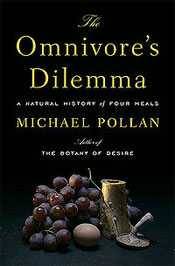
This may be the most important book about food since Upton Sinclair’s The Jungle drew back the curtain on the Chicago stockyards in 1906. Both books take an analytical and critical look at how food gets to our table. The New York Times named The Omnivore’s Dilemma one of the 10 best books of 2006.
Pollan documents in fascinating detail how food and feed are grown, how government influences what we eat, and how what we eat influences our health, our environment, our politics, and our humanity.
He begins by reminding those of us old enough to remember that a cross country trip in the 1970s meant the strobe of farms populated with horses, beef cattle, dairy cattle, chickens, pigs, a seasonal vegetable, and fruit trees. Now such a trip reveals unbroken rows of corn and soybeans, monotonous “monocultures.” Corn, it seems, has subsumed everything beginning with some innocent sounding decisions by the Nixon administration, and it now is the vast industry whose by-products find their way into 25% of the products in the packaged goods in the grocery store. It is in all the animals we eat, and just about everything we eat with them. It is even in the toothpaste we use to clean up after. “Tell me what you eat,” said Brillat-Savarin, “and I will tell you what you are.” We are corn.
He goes on to demonstrate how corn has allowed a handful of politically powerful huge multinational conglomerates to control pricing of almost all farm products and have driven calories per acre yields to incredible records while driving the profit per acre for the farmer to the point of bankruptcy.
He shows how the quest for cheap calories has impacted our diets and the far reaching impact on everything including our health care system. He shows the relationship of our dependance on corn on our dependance on foreign oil, and I’m not talking corn oil.
His descriptions of the confined feedlot operations (CFOs) on which cattle are fattened for slaughter are revelatory. But he is not just another food Nazi. Some of his greatest surprises are found in his section describing the organic food industry and how far it has strayed from its roots.
In the final chapter, he hunts wild hog and enters into a tortured debate with himself over the morality and the benefits and disadvantages of eating meat. He asks all the right questions, and quotes positions of proponents of many of the various positions. It is one of the most informed unbiased debates I have seen on the topic.
Pollan is insightful, thoughtful, deadly serious without being pedantic (well, just a little), and occasionally witty.
There are some slow spots in the book, but the first 200 pages are riveting. This is a must read for people who love food, love the commonwealth, and wonder what the future holds.
Buy The Omnivore’s Dilemma from the Apple iBook Store
Buy The Omnivore’s Dilemma from Amazon