


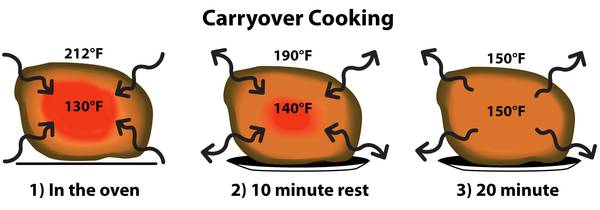
Just because you have taken food off the heat, doesn’t necessarily mean you are done cooking. Cooking can continue for 20 minutes or more, even at room temp, and take a perfect medium rare steak and ruin it by raising its temp to medium well. This phenomenon is called carryover cooking. Here’s how it works: Hot air cooks the outside of the food. The outside of the food cooks the inside of the food by conduction. When we remove the meat from the heat, it continues to cook because the heat built up in the outer layers of the meat continues to be passed towards the center. A beef roast, for example, is about 75% water and perhaps 15% fat. Both are good insulators. As a result, meat collects heat slowly, and it transfers it slowly.
1) In the oven. In the left image we see a cross section of a piece of a hypothetical beef roast while it is being cooked, absorbing heat from hot air on all sides. The hot air warms the surface of the meat, and the molecules start vibrating rapidly. These throbbing molecules get their neighbors pumped up, they pass along the vibe, and the party continues slowly and gradually towards the center by conduction, like a wave at a football game, until all the molecules are doing an end zone dance.
When it hits 130°F in the center, medium rare, we remove it from the heat. The exterior has a nice dark brown crust beneath which is a band of brown meat, then tan, then pink, and finally a cylinder of beautiful rosy medium rare. The exterior cannot rise more than a few degrees beyond 212°F even when it dries and forms a crust or bark.
2) 10 minute rest. In the center image the meat has been removed from the oven or grill or smoker. Yet heat continues to be passed towards the center, slowly cooking it even though it is sitting at room temp. But because the surrounding air is now cooler than the meat, some of the heat escapes into the room and the outside cools as energy moves away in two directions. The exterior remains dark brown and crusty on most sides, but gets soft on the bottom. The cylinder of medium rare has moved into the medium range.
3) 20 minute rest. On the right, the meat has come close to an even temp throughout and now more heat is escaping than moving inside. The crust has cooled while the center has warmed and the two are pretty much the same temperature, medium well. Meanwhile moisture from the inner layers has moved into the drier outer layers, softening the crust. The roast has approached equilibrium, and is approaching the point at which you have to start apologizing.
Factors impacting carryover
Cooking temperature. The hotter we cook, the more energy we are packing into the outer layers, so the carryover will be greater than if we cook at a lower temp. At lower temps cooking takes longer and more heat migrates to the center. If we are cooking a roast at high temps, say 350°F, carryover can be up to 20°F. If we are cooking at low temps, say 225°F, carryover might only be 5°F. Thickness, as always, is a major factor. Carryover is one reason why you should start roasts at a much lower temps than most cookbooks say, why you should not put roasts in roasting pans but hover them above the pan, and why you should not rest meat after cooking, but carryover is one of several reasons.
Thickness of the meat. Really thin cuts like skirt steak for fajitas don’t have time to build a large heat reservoir unless they are cooked scorching hot, so there is little carryover. But the carryover on a 1 1/2″ steak with a good dark, all-over sear can be significant because the center is closer to two heat reservoirs. If we cook a steak to 130°F, medium rare, and then let it sit on a plate for 10 minutes, especially if we tent it with foil as some recipes tell us to, the center of the meat can easily work its way up to 145°F, and the crust will get soft. So get your steaks off at lower temps than you want to serve them at, and move them to table immediately and start carving roasts and poultry soon after you bring them in, the heat rapidly dissipates from the increased surface area and carryover comes to a screeching halt. Thick pieces of meat are like batteries, holding more energy than thin pieces of meat.
Here’s a great video by food scientist Chris Young on the topic
The AmazingRibs.com science advisor Prof. Greg Blonder has done some fascinating experiments with carryover. Click here to read about them and see his charts and graphs.