


It is conventional wisdom that you should soak wood chips and chunks for a few hours before using them in a charcoal or gas grill or smoker. All the books say so.
The proof is in the weighing
Since the best smoke woods are hardwoods, fruitwoods, and nutwoods, to test the concept, I began by weighing two handfuls of wood chips, and two handfuls of wood chunks on a digital scale. Both bags were labeled “apple”. Then I soaked them in room temp water for 12 hours, took them out, shook off much of the surface water, patted the exterior lightly with paper towels and weighed them to see just how much was actually absorbed. Large chunks gained about 3% by weight and small chips about 6%. That’s not much. Chips absorbed a bit more because there was so much more surface area than chunks.
The proof is in the coloring
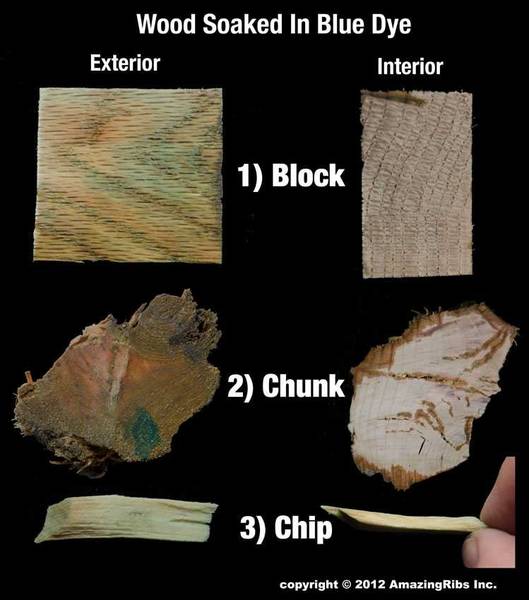
To see just how far water penetrates into wood, I soaked three pieces of wood for 24 hours in a mix of water and blue food coloring. I then rinsed the surfaces and patted them dry with a paper towel. I photographed the exteriors. Then I cut the wood in half and photographed the interiors. As you can see from the pictures at the top of the page, the dye discolored the surface only a little, mostly where there is peach-fuzz from the cutting and chipping process, and water and the dye entered the interiors only where there were cracks and fissures. The rest of the wood is bone dry.
1) This is a solid block of oak. It is about 2″ x 2″ x 1″. On the exterior you can see that some die has penetrated the soft part of the grain. On the right, you can see a cross section after I cut the block in half. There is no visible penetration on the sides except for a thin crack in the wooden the top left.
2) This is a chunk of cherry. It is about 3″ in diameter across the widest part. On the left you can see that the water stained the outside edge where the grain is running perpendicular to the camera. On the right you can see that the water penetrated through several cracks and along a few rough edges. But the wet wood is probably only about 10%.
3) This is a chip of cherry. It is about 1 1/4″ long and 1/2″ wide. On the left you can see the dye has lightly colored much of the surface, but if you snap the wood and inspect the cross section, the penetration is probably about 1/64″.
Conclusion. After 24 hours, water barely penetrates solid wood and slightly penetrates cracks. Most books recommend soaking for only an hour or two. Fogeddaboudit.
Now I know a few of you are going to tell me that your deck and picnic tables absorb wood. That’s because they are loose grained woods, usually pine, and they have been parched by the sunlight. But fruitwoods, nutwoods, and other hardwoods have very tight grain and about 10-25% moisture within.
What happens to wet wood on a grill?
There’s another good reason to not soak your wood. If you toss dripping wet wood on hot coals, the water will cool off the coals. But the key to good cooking is controlling your temperature. The goal is to get to a target temp and hold there. Nice and steady.
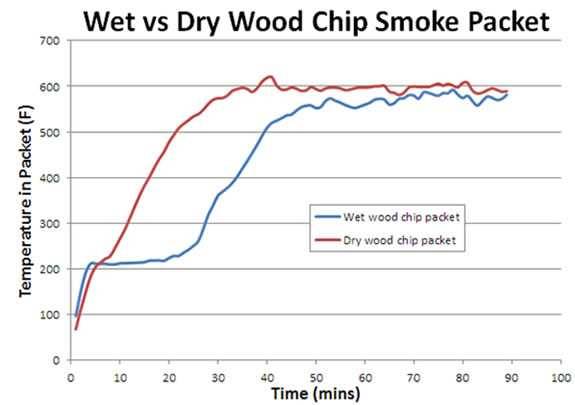
Let’s say the coals or gas jets are 600°F on their surface. If the wood surface is wet the wood cannot heat much beyond 212°F, water’s boiling point, until it evaporates by turning to steam. The wood’s surface temp sticks at 212°F. After the water is driven off, the wood starts to warm and when the surface hits the combustion point, about 575°F, it begins giving off gases. It can then combust and produce smoke. Click here to read more about how wood makes smoke and the different phases of combustion.
You might think you see smoke when you toss on wet wood, but it is really steam. Here is a test the AmazingRibs.com science advisor Prof. Greg Blonder did with two wood chip packets. Both had 50 grams of wood, but he soaked one in water. Both went on top of a 600°F heat source. The dry wood (red line) rose in temperature rapidly to the combustion point. The wet wood rose rapidly to the boiling point of water and stalled there for almost 30 minutes. When it dried out, it rose rapidly to the same temp as the dry packet and began to combust and produce smoke. Now the exact elapsed time will vary depending on the oxygen supply, but you get the picture.
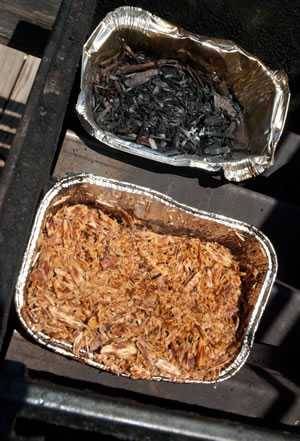
I have used this to my benefit. I will sometime put two small foil loaf pans of wood on the grill, and pour water in one. The dry one will start to smoke in short order and by the time it peters out, the water will have evaporated from the second one, the smoke time bomb, will kick in.
One more reason not to soak: Not all smoke is the same. The best tasting smoke is practically invisible, thin, and pale blue. Blue smoke is better than white, gray, or black, by far. Blue smoke needs dry wood and a hot fire, lots of oxygen and flame. Some people complain that their chips catch on fire when they throw them on the coals. To prevent this they make a smoke packet by wrapping the wood in foil and poking holes in the foil. Don’t bother. Let the wood burn! That’s how you get blue smoke! Click here to read more about wood and the different kinds of smoke.
Planking: An exception to the rule, sort of
Plank cooking is a method of cooking food on top of a wooden plank. The technique calls for soaking the plank in water. The theory is that by soaking we prevent the plank from bursting into flame and the steam created on the top surface under the meat helps with cooking. Alas, not much water soaks into the plank, and not much steam hits the food, but if you don’t soak it, you’ll have a bonfire with your dinner the star of the show. Click here for more on planking.