

Real soy sauce (a.k.a. soya sauce, shoyu, tamari) is made by fermenting soy beans and other grains, and has salt and water added. The process has been around for 2500 years. It is salty, complex, and high in natural glutamates, amino acids that amp up the flavor of food called umami. Think of it as liquid salt with a flavor amplifier built in.
The soybeans are soaked, sometimes boiled, then mixed with the other grains, typically wheat, and fermented by yeasts and other microbes in a culture called koji. It is then pressed to separate the now dark brown liquid from the spent solids, then pasteurized, and aged and bottled.
The result is called light soy sauce and you can see this term on some labels. If it is aged longer it can darken and intensify in flavor, and is sometimes labeled as dark soy sauce. Some dark soys have caramel coloring or molasses added. Without getting too complicated, it will suffice to say that dark soy sauce is more concentrated, richer, and more intense. Like dark coffee vs. light coffee. Exact production processes vary from country to country and brand to brand. In Japan, soy sauce is called tamari sauce, and it tends to be a bit less salty and, I think, better balanced. Some tamari sauces are wheat free. In recent years, in a nod to those salt restricted diets, several brands have introduced “low sodium” soy sauces. Keep in mind, “low sodium” is a relative term. They are still pretty salty. I think the Kikkoman Low Sodium is pretty good stuff, in fact I prefer it to the regular, and not for health reasons.
I have been known to buy dark soy, and if the recipe calls for light, I dilute it with about 10% water. I’m too lazy to stock both. Most commercial brands are closer to dark soy sauce than light.
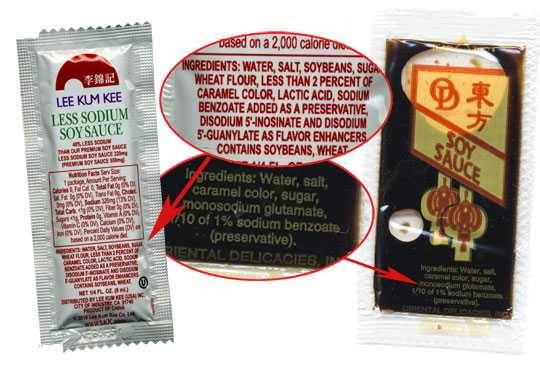
When a recipe calls for soy sauce, before you grab those leftover packets from Chinese carryout, grab a magnifying glass. It may not be real soy sauce. Take a look at the two packets shown here. Soybeans are third on the list of the Lee Kum Kee Low Sodium Soy Sauce. This is typical of real soy sauce. Notice that there are no soybeans in the generic “Soy Sauce” on the right! Kikkoman brand soy sauce, now made in Wisconsin, is ubiquitous in Chinese restaurants in the US and is the brand I use in my recipes. The ingredients list of their “Naturally Brewed Soy Sauce” says “Water, wheat, soybeans, salt, sodium benzoate: Less than 1/10 of 1% as a preservative.” That’s soy sauce!
There are small artisan producers whose bottles are sought after like rare wines. If you can find a Chinese grocery, you can buy imported soy sauce by the quart or gallon. Cheap.