

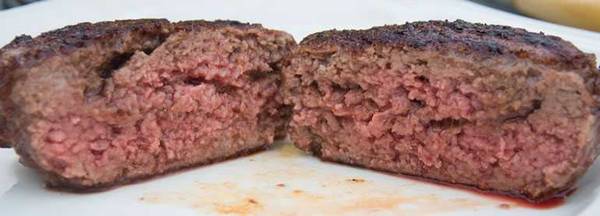
Undercooked ground meat and sausage can kill. It can happen to you or someone you love. It usually happens at home, but it can happen at restaurants. In 1993 four children died from hamburgers contaminated by the virulent bacteria pathogen Escherichia coli O157:H7 purchased at Jack in the Box restaurants.
According to health officials, as many as 70,000 Americans fall ill from E-coli O157:H7 each year, most of them as a result of tainted hamburger meat. According to USDA, “the very young, the very old, and those with immune systems that have been weakened by cancer, kidney disease, and other illnesses are most at risk and vulnerable to illnesses associated with contaminated food.” If someone shows symptoms of illness, do not hesitate to get to the emergency room in a hurry.
We’ll call this common bug E-coli for short from now on, although there are many other strains of E-coli that are harmless. In addition to E-coli, Salmonella, Campylobacter jejuni, Listeria monocytogenes, and Staphylococcus aureus, can be found in ground beef and can cause illness. They cannot be seen or smelled. There are also spoilage bacteria that are harmless to humans but deteriorate the meat’s quality.
In meat, E-coli comes from fecal matter in the intestines of the cow. It gets on the surface of the meat during butchering from
(1) fecal matter that is on the hide because feed lots are crowded with cattle and their waste,
(2) fecal matter in the intestines if they are accidentally sliced open during butchering, a common occurrence
(3) fecal matter that spilled from intestines onto the floor of the slaughterhouse or packing shop, or
(4) from knives, grinders, tables other equipment, from other meat, or hands that have come in contact with fecal matter.
Contaminated meat then is transported across several state lines in refrigerated trucks that are not always at the proper temp, unloaded into butcher shops and can often sit on the dock or the warehouse for too long, and then moved to cool rooms that may not be cold enough because people don’t like it too cold when they work.
E-coli O157:H7 is primarily a problem in ground meats, not steaks. It is found only on the surface of the steaks. They do not work their way into the muscle or fat far beyond the surface. They die rapidly when you cook a steak’s surface past 160°F, even if the interior is bloody rare. If your grill is even at a low 225°F, the exterior of a steak will hit 160°F fairly quickly and be safe. The problem arises when meat is ground. Then the outside gets inside and rare burgers or medium rare burgers carry risk with them because they are not cooked to 160°F. Because grinding is how the bug gets into the meat, E-coli is a problem for all ground meats and sausages unless they have been pre-cooked like hot dogs or treated with preservatives.
If the butcher’s grinder is not in a cool room, contamination on it can grow rapidly (e-coli doubles in 20 minutes). Then we have to hope that the butcher’s grinder is kept clean. They are usually old and the older models are hard to clean properly, with lots of nooks and crannies for contamination to hide in. Then it goes into an open-top display case and can sit there for hours, and the trays on the bottom may be there for days. They then sit in uncalibrated home refrigerators for days sometimes.
Industry and government inspection for E-coli is not very thorough. The detection process is expensive, there are not enough inspectors, and USDA inspects only meat headed for interstate commerce. Some meat is inspected by state inspectors, and most is not inspected at all. If your trusted grocer is sold contaminated meat and grinds it, it can contaminate the grinder and all the meat ground that day. Knowing your butcher is not a guarantee of safety.
It is important to remember that “sell by” dates are no guarantee of safety. USDA recommends that you store ground meat at 40°F or lower and that you cook or freeze it within two days after purchase. E-coli does not reproduce at cold temps.
Now here’s an interesting question: Some fast food joints promote the fact that their burgers are never frozen. So which would you rather eat, a burger that is frozen right after grinding and shipped to a franchise three states away, or a burger that is not frozen and shipped three states away?
You can read more about E-coli, how it gets into hamburgers, and the nature of the problem in an excellent article in the New York Times. Click here to read the USDA article on ground beef safety.
If you must have medium-rare burgers, there are three ways
If you want rare burgers, there are some options:
(1) Buy irradiated beef. My research tells me irradiated beef is perfectly safe and healthy. But it is hard to find because a lot of people are scared of radiation in all forms (except when they get their teeth and bones X-rayed, and that’s a LOT higher dosage).
(2) Sous vide. You can also have rare burgers by using the sous vide method of slow cooking the patties in a bag in an immersion bath of 131°F water for two hours.
(3) Pasteurize the meat. Food scientists say that if you dip a steak in boiling water (212°F) for 20 seconds before grinding it yourself, it is made safe. I have tried it, and although the exterior turns gray, it grinds well and makes fine flavorful rare patties. I use the method in this video. And for those of you with really sharp eyes, the bacon had been dipped off camera and before I chopped it, so it was safe, and after I pasteurized the steak I cleaned the cutting board before I put it down. That’s my story and I’m stickin to it.
Video: Making Medium Rare Burgers
Meathead shows you how to safely cook burgers medium rare.
Ask yourself this first
If you use a high fat blend and patty and season it properly, if you add condiments, onion, lettuce, tomato, and a buttered bun, most people cannot tell the diff between a 135°F burger and a 160°F burger if they are blindfolded.
If you do not have sterile meat, and you are healthy and not too young or old or immune compromised, you can take the risk of eating a rare burger. Go ahead and roll the dice. Probably safer than riding in a NY cab. But if your kids or granny can’t tell the diff, why risk it?